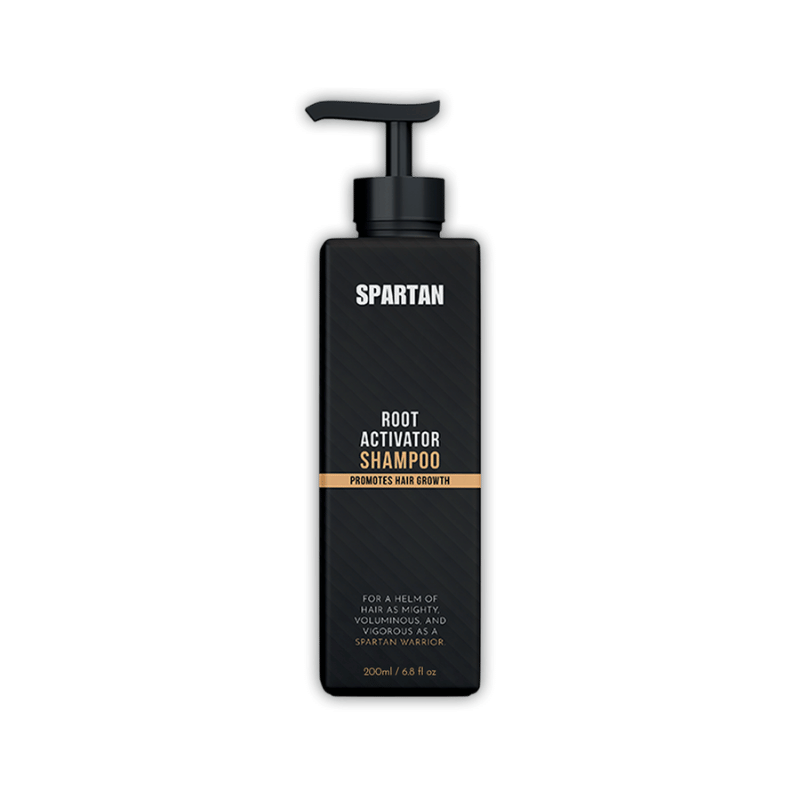
You have noticed it. The drain after a shower. The photo from
behind that caught you off guard. The part in your hair that is
wider than it was a year ago.
You have probably Googled it. Read about genetics. Read about
stress. Read that it is “just part of getting older.”
None of that explains what is actually happening.
Because hair loss is not random. It is not bad luck. And for the
vast majority of men experiencing thinning, it is being driven
by one specific biological process that has a name, a mechanism,
and — importantly — a solution.
The process starts with a hormone called
DHT —
dihydrotestosterone.
And until you understand what DHT is doing to your follicles
right now, nothing you try will make sense. Not the shampoos
that did not work. Not the supplements that changed nothing. Not
the prescriptions you read about and closed the tab on.
This article is going to walk you through all of it. What DHT
is, how it destroys hair, why common treatments fail, and what
the latest research shows actually works.
WHAT IS DHT — AND WHY IS IT THE #1 DRIVER OF MALE HAIR LOSS?
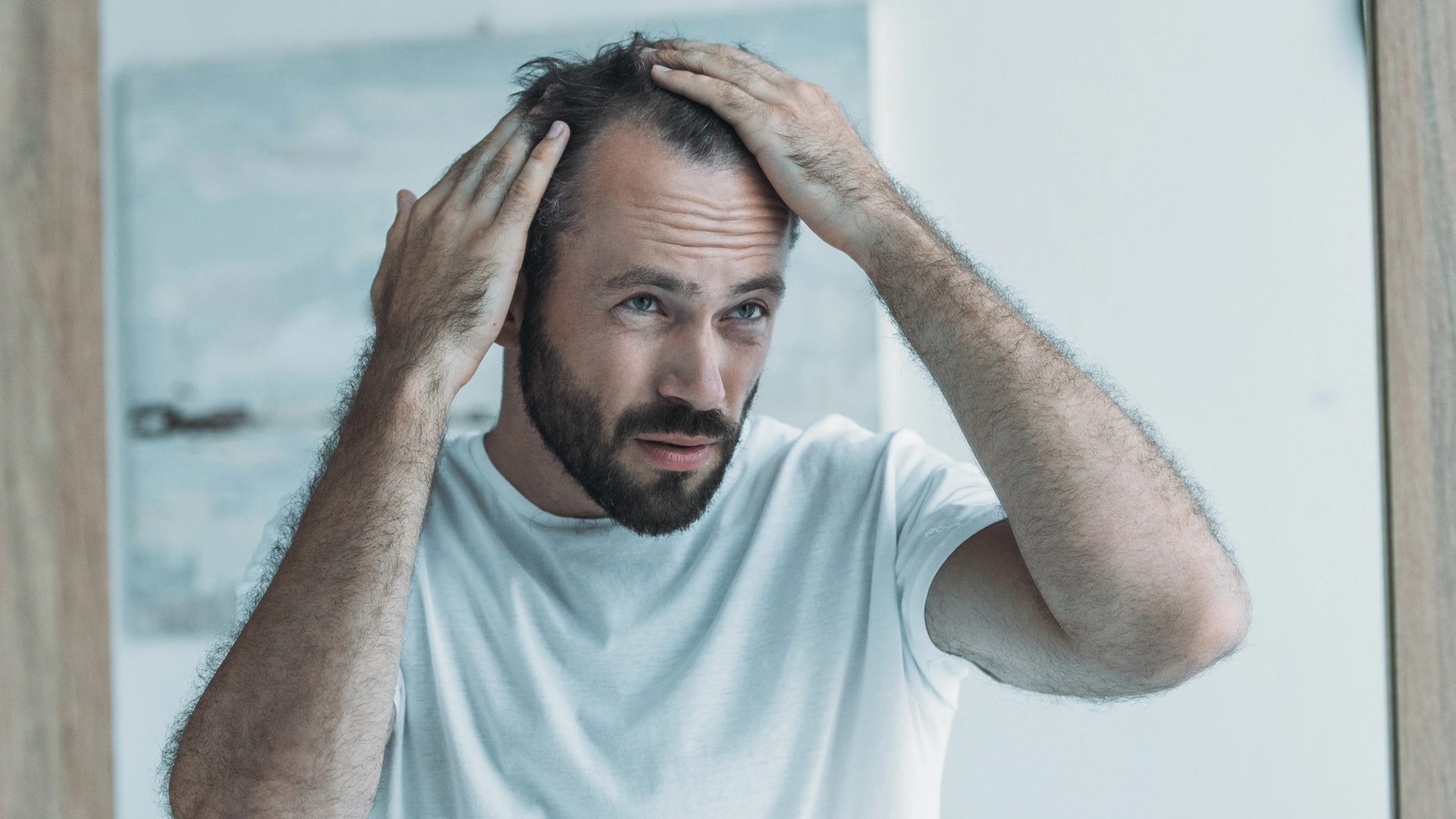
Your body produces testosterone. That is normal. But an enzyme
called 5-alpha reductase converts a portion of that testosterone
into a more potent androgen: dihydrotestosterone, or DHT.
DHT is not inherently bad. It plays a role in male development
during puberty. But in the hair follicles on the top of your
head — the hairline, the temples, the crown — DHT does something
destructive.
It binds to receptors at the base of the follicle. And once it
latches on, it triggers a cascade that progressively shuts your
hair down.
Here is exactly how that works.
THE THREE STAGES OF DHT HAIR DESTRUCTION
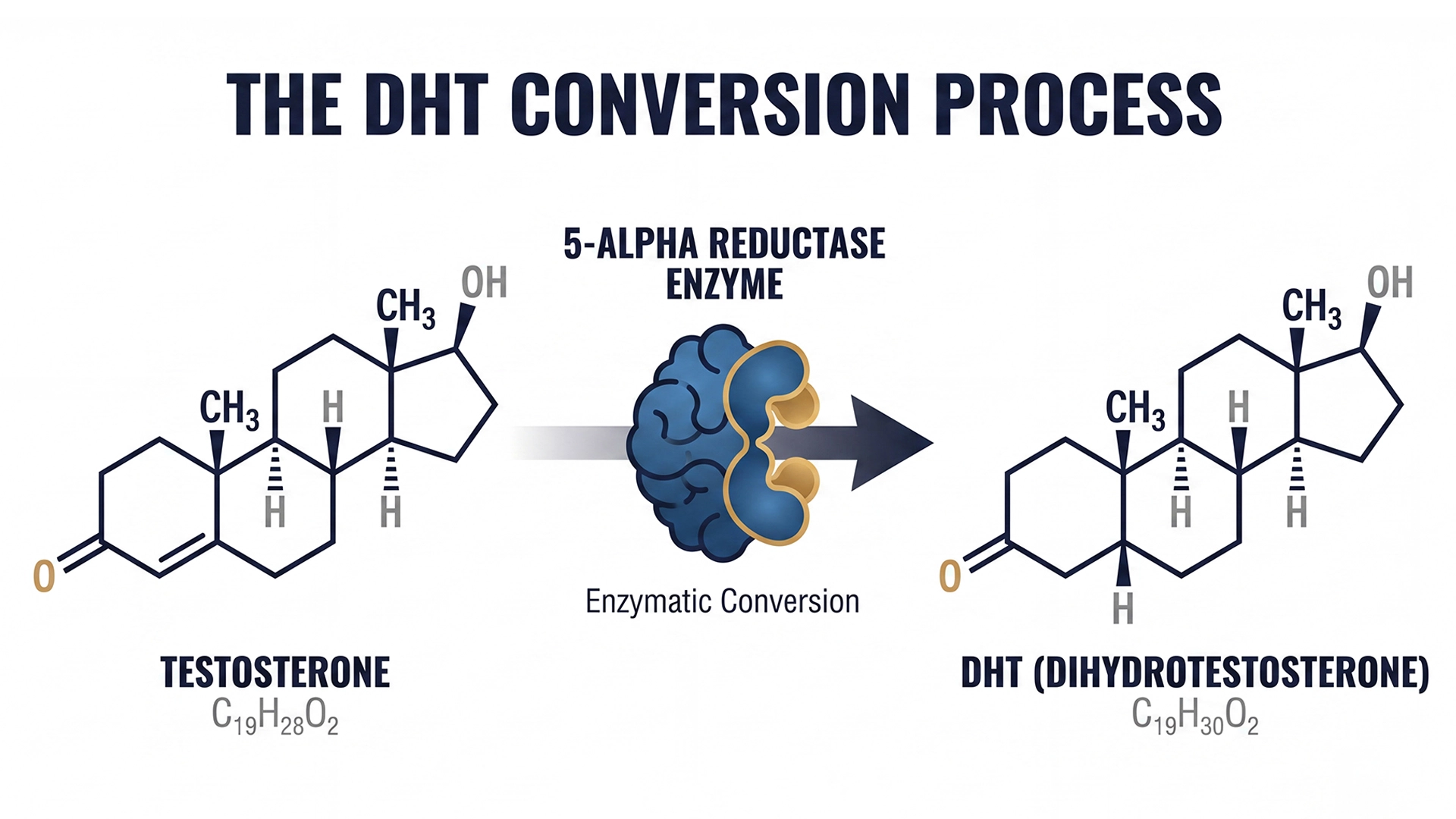
Stage 1: DHT binds to the follicle.
DHT molecules attach to androgen receptors at the base of your
hair follicle. The follicles at the front and top of your scalp
have far more of these receptors than the ones at the back and
sides. That is why hair loss follows a pattern — it is not
random thinning, it is targeted destruction by a hormone that
has a higher concentration of receptors to bind to in specific
areas.
Stage 2: The follicle shrinks.
Once bound, DHT triggers follicular miniaturization. The
follicle physically gets smaller. The blood supply feeding it is
reduced. The dermal papilla — the structure at the base that
controls growth — shrinks. Each cycle, the follicle produces a
thinner, weaker, shorter hair. What used to be a thick terminal
hair becomes a barely-visible vellus hair. This is the thinning
you see in the mirror.
Stage 3: The growth cycle collapses.
At the same time, DHT shortens the anagen (growth) phase and
extends the telogen (resting) phase. A follicle that used to
grow hair for 4-6 years now grows it for months, then weeks. The
rest phase stretches from 3 months to 6, to 12. More shedding.
Less regrowth. The follicle spends more time dormant and less
time producing.
The end result: thinner hair, fewer hairs, and follicles that
eventually enter
prolonged dormancy.
THE PART MOST MEN GET WRONG
Those follicles are not dead.
This is the single most important thing to understand about
DHT-driven hair loss. The follicle has been shrunk, starved of
blood, and pushed into extended rest — but the cellular
machinery is still there. The follicle still exists beneath the
scalp surface.
It is dormant. Not destroyed.
Which means it can be reactivated — if you do three things:
1. Stop DHT from binding to the follicle.
2. Restore blood flow so the follicle gets oxygen and
nutrients again.
3. Deliver the specific growth signals that tell
dormant follicles to re-enter the growth phase.
Block DHT. Restore blood flow. Feed the follicle.
That is the complete mechanism. And that is where every common
treatment falls short.
WHY FINASTERIDE, MINOXIDIL, AND SUPPLEMENTS KEEP FAILING YOU
Once you understand the three-stage mechanism, the failures become
obvious.
Finasteride
blocks DHT systemically — throughout your entire body, not just
at the scalp. That is Stage 1. It works for that one stage, but
it does nothing for blood flow (Stage 2) or follicle
reactivation (Stage 3). And the systemic DHT suppression is what
drives the side effects every man has read about: sexual
dysfunction, depression, brain fog. The European Medicines
Agency has confirmed these are real, documented effects. You are
addressing one stage of a three-stage problem and paying for it
with side effects that affect your whole body.
Minoxidil
increases blood flow to the scalp. That is Stage 2. But it does
not block DHT at all. The hormone that caused the damage is
still active, still binding, still shrinking follicles. That is
why minoxidil results plateau and why everything reverses when
you stop. You are feeding follicles that are still under
hormonal attack. It also requires twice-daily application for
life and only has FDA-demonstrated efficacy on the crown — not
the hairline where most men notice thinning first.
Microneedling devices
puncture the skin barrier to stimulate a healing response. The
theory is sound, but these devices sit on bathroom shelves
collecting bacteria. The clinical literature documents
folliculitis — bacterial infection of the follicle — from
contaminated devices. The inflammation from infection
accelerates the same DHT-driven miniaturization you are trying
to stop.
Biotin, saw palmetto, collagen, and supplements
do not reach the follicle in meaningful concentrations when
taken orally. They support general health the way a multivitamin
does. They cannot override a hormonal mechanism happening at the
cellular level of the follicle.
The shampoo already in your shower was designed to clean hair.
Not to deliver active compounds to the follicle. Not to block
DHT. It rinses out in 30 seconds and takes everything with it.
None of these treatments address all three stages. Most address
only one. Some address zero.
That is not a subtle distinction. That is the entire reason
they did not work.
WHAT WOULD A COMPLETE SOLUTION ACTUALLY LOOK LIKE?
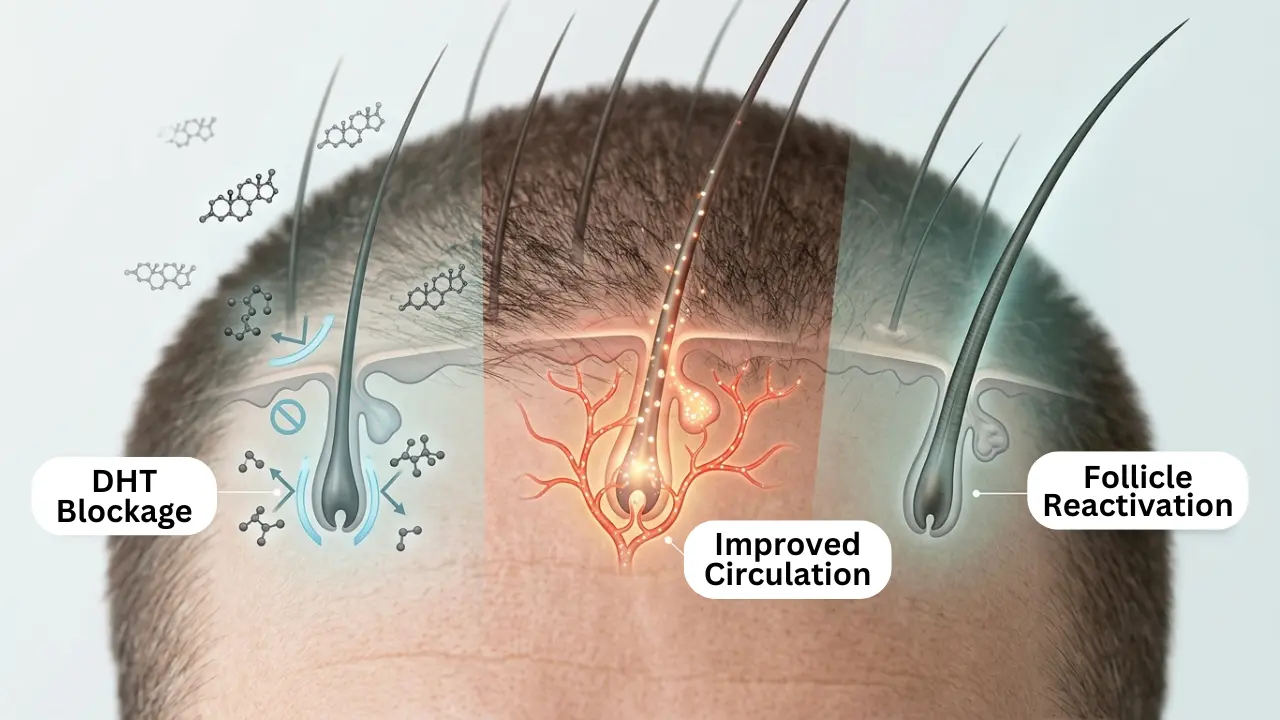
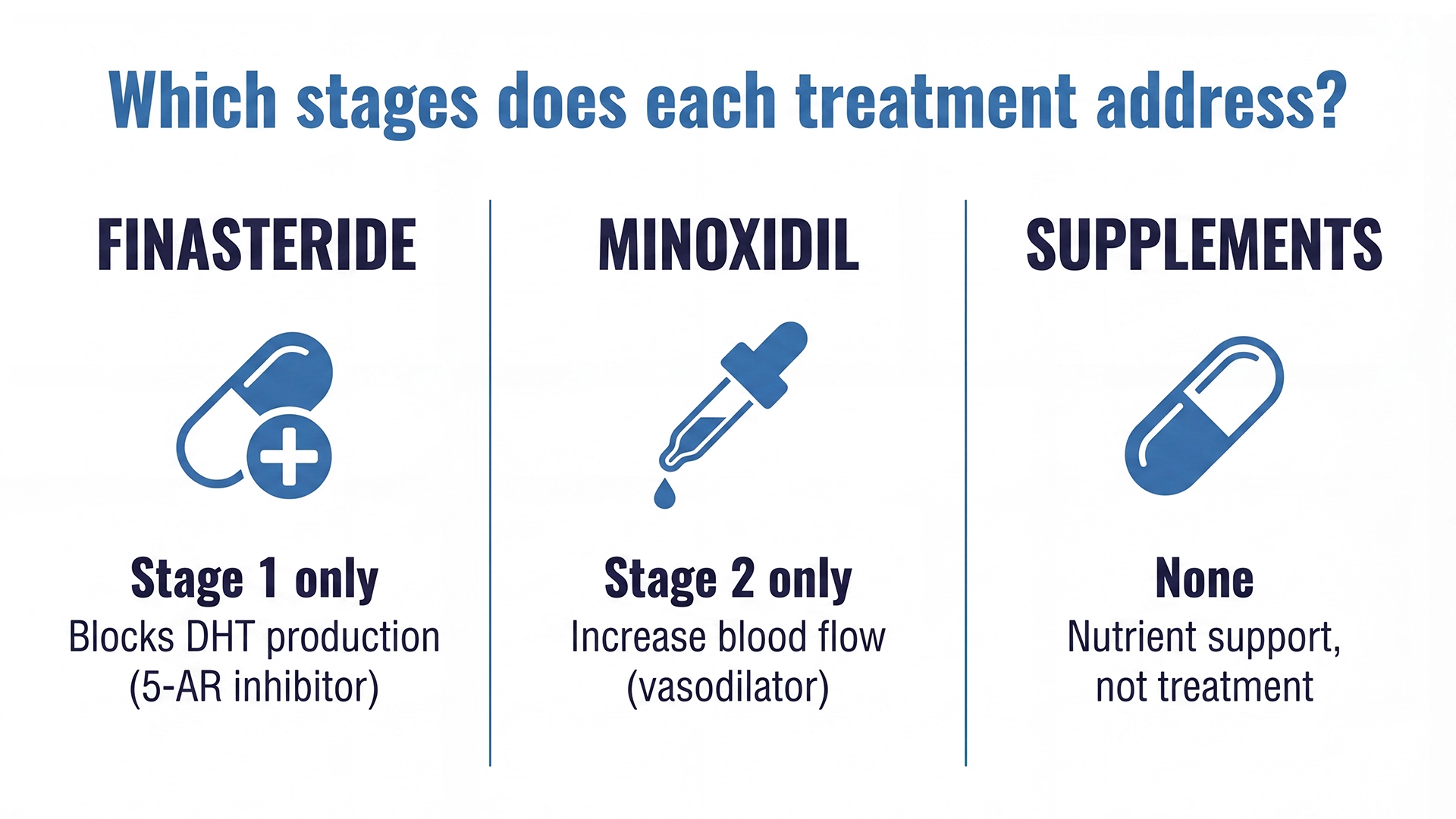
So if finasteride only addresses Stage 1, minoxidil only
addresses Stage 2, and supplements address none of them — what
would it actually take to address all three?
You would need a formula that does three things simultaneously,
at the scalp level, without systemic side effects:
1. Shut down DHT production where it matters — at the
follicle, not throughout the entire body.
2. Restore the blood flow that miniaturization choked off.
3. Deliver the specific growth signals that tell dormant
follicles to wake up and re-enter the growth phase.
Over the last decade, peer-reviewed research has identified
botanical compounds that can do each of these things topically.
Not folk remedies — compounds with published evidence for
modulating the same enzymes and pathways that prescription drugs
target, without systemic exposure.
Until recently, no single product addressed all three stages.
Most targeted one. Some targeted two. None delivered DHT
suppression, blood flow restoration, and follicle reactivation
through a single topical application.
SPARTAN ROOT ACTIVATOR SHAMPOO: THE FIRST FORMULA BUILT FOR ALL
THREE STAGES
Spartan Root Activator Shampoo was formulated to change that. It
is a 100% natural, sulfate-free shampoo built specifically
around the three-stage DHT mechanism — and here is what happens
inside the follicle during the 2 minutes it sits on your scalp.
The first thing the formula does is shut down DHT production
at the scalp. Glycyrrhizin — the active compound in licorice root —
suppresses the 5-alpha reductase enzyme. That is the same enzyme
finasteride targets, but delivered topically instead of
systemically. No hormonal disruption elsewhere in the body. No
side effects beyond the scalp. Sophora flavescens reinforces
this through a second inhibition pathway documented specifically
for male hair loss, and caffeine penetrates the follicle
directly to override the growth-suppressing signal that DHT
sends to hair matrix cells. Three compounds, three pathways, all
converging on the same goal: stop DHT from shrinking your
follicles.
With DHT suppression in place, the formula restores what
miniaturization took away: blood flow.
Peppermint oil increases scalp microcirculation on contact — a
2014 study showed it outperformed minoxidil in promoting hair
growth. Rosemary oil matched minoxidil head-to-head in a
clinical trial at six months, without the dependency, the scalp
irritation, or the rebound loss when you stop. Ginseng amplifies
the vasodilatory effect while pulling double duty as an
additional DHT blocker. Ginger root reduces the chronic
low-grade inflammation that builds up in a scalp that has been
under hormonal attack for years. The follicles that have been
starved of oxygen and nutrients start receiving both again.
The final piece — and the one most treatments ignore entirely
— is waking the dormant follicles back up.
Eclipta prostrata modulates the growth factors, including FGF-7,
that signal follicles to transition from rest back into active
growth. Melatonin extends the growth phase itself, keeping
follicles in production mode longer. And a nutrient complex
including black sesame, polygonum multiflorum, and biota
orientalis delivers the raw materials follicles need to produce
thick, healthy hair once the DHT block is in place and blood
flow is restored.
That is the complete mechanism in a single application. DHT
suppression, blood flow restoration, and follicle reactivation —
delivered directly to the scalp every wash. The formula is
100% natural, sulfate-free, paraben-free, and compatible with all hair types. It is safe to use
alongside minoxidil or finasteride if you are currently on
either.
HOW IT WORKS: 2 MINUTES, 4 TIMES A WEEK
The application is simple. You use it like any other shampoo.
Lather. Leave on the scalp for 2 minutes. Rinse.
That 2-minute window is the active delivery period. The
botanical compounds absorb into the scalp and go to work at
the follicle level — suppressing DHT, opening blood flow, and
delivering growth signals to dormant follicles.
Four washes a week. In the shower you are already taking.
During the routine you already have.
No twice-daily applications. No pills to remember. No devices
to sterilize. No prescriptions.
The routine does not change. What happens inside the
follicle during that routine changes completely.
WHAT TO REALISTICALLY EXPECT
Let’s be direct: your hair is not going to grow back in 7 days.
Anyone who tells you otherwise is lying. Hair growth is a
biological cycle. Any legitimate treatment — natural or
pharmaceutical — requires time.
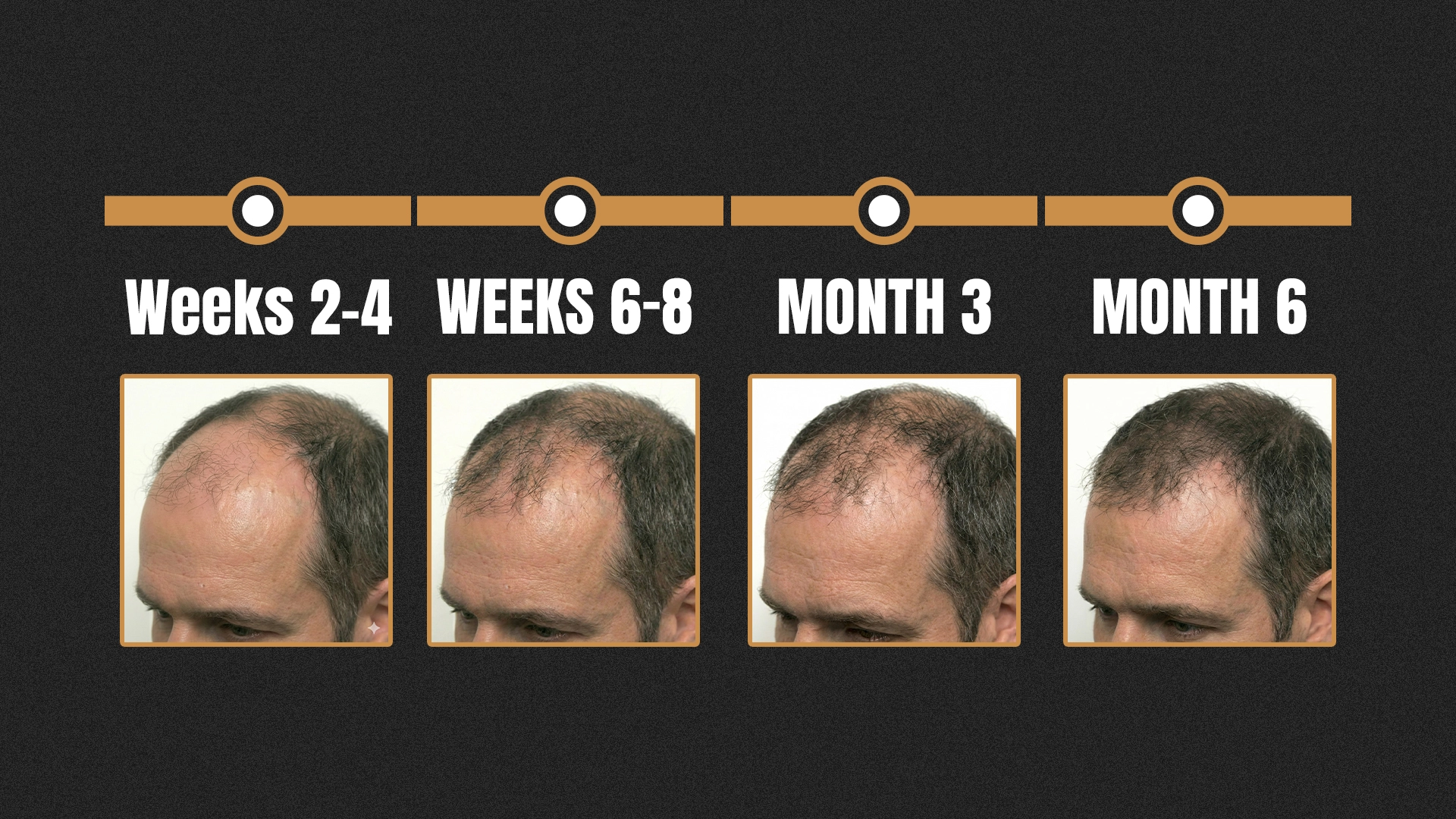
Here is what consistent users typically report:
Weeks 2–4:
Scalp feels different. Less oily, less irritated. Reduced
shedding in the shower drain — the first sign that DHT is being
addressed at the follicle level.
Weeks 6–8:
Baby hairs start appearing. Fine new growth at the hairline and
crown. These are dormant follicles re-entering the growth phase.
Month 3:
Visible improvement in density. The thin patches start filling
in. This is the point where most men look in the mirror and see
a real difference.
Month 6:
Full results. Studies show men who used DHT-blocking botanical
formulas consistently for 6 months saw up to 3x more regrowth
compared to those who stopped at 1–2 months.
The shampoo cannot override the fundamental biology of hair
growth. But it can work with it. And when you give follicles
what they need consistently over a full growth cycle, the
biology does what biology does.
It recovers.
WHAT MEN ARE REPORTING AFTER 90+ DAYS
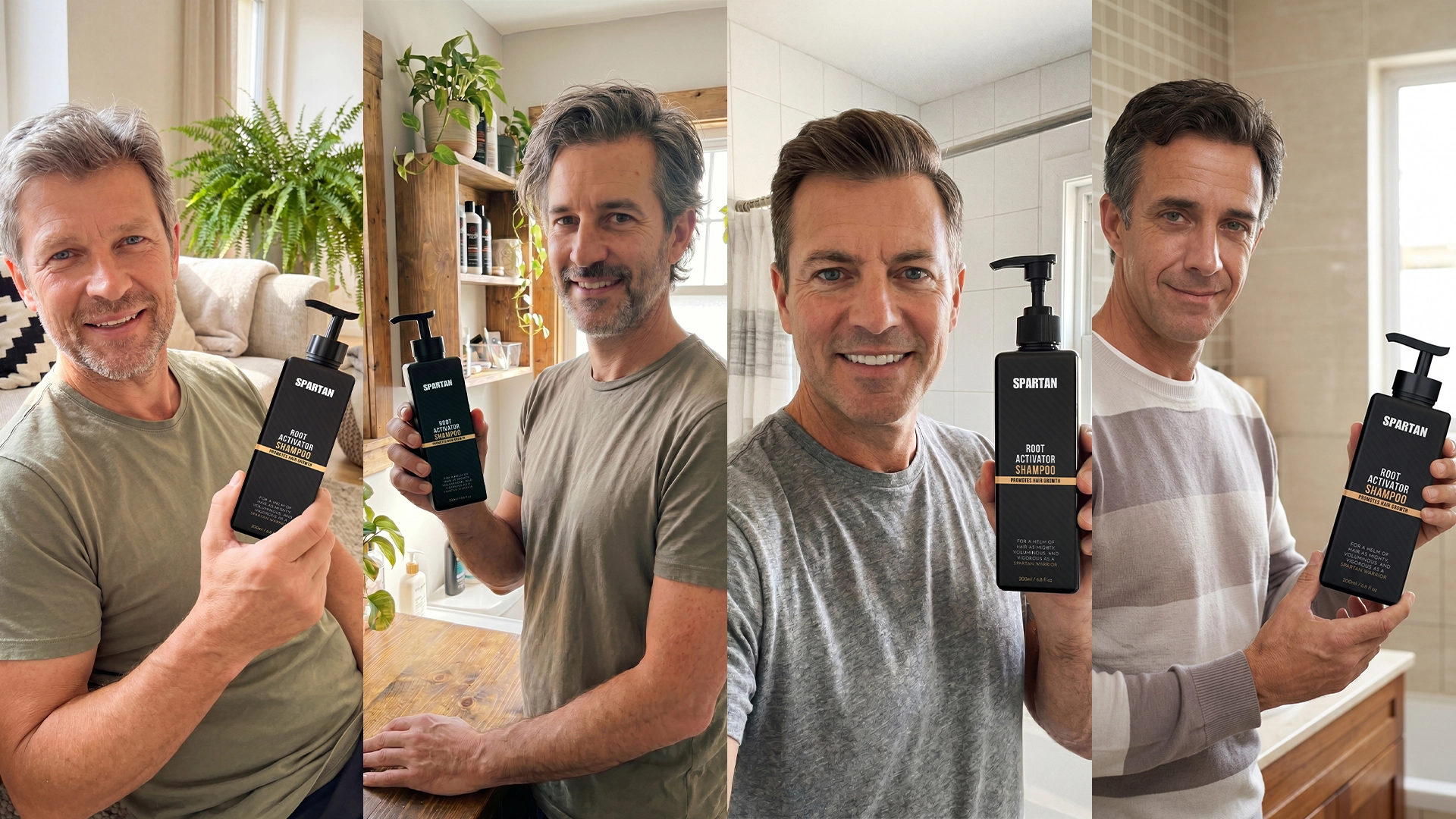
Robert K., 47 — Austin, TX ⭐⭐⭐⭐⭐ “I was on finasteride for two years. The side effects were
real — I just did not want to admit it. Switched to Spartan
because I figured a shampoo was the lowest-risk thing I could
try. Four months in and my wife noticed before I did. She said
my hair looked ‘fuller.’ That was the first positive thing
anyone had said about my hair in five years.”
David M., 53 — Denver, CO ⭐⭐⭐⭐⭐ “I had tried everything. Minoxidil twice a day for three
years. Biotin. Saw palmetto. A laser cap that cost me four
hundred dollars and collected dust. My barber told me about
Spartan. Three months later he is cutting hair at my temples
that was not there before.”
Steven L., 39 — Chicago, IL ⭐⭐⭐⭐⭐ “I do not buy things because of marketing. I read the
ingredients on the Spartan bottle, looked up every single
one, and found published studies for all of them. That is
what convinced me. The science. And the results matched.”
Mark T., 58 — Scottsdale, AZ ⭐⭐⭐⭐⭐ "“At 58 I had accepted it. My doctor said it was just age.
Five months in, the thin patch at my crown is filling in.
My wife keeps running her hand over it and saying she
cannot believe it. Neither can I.”
WHAT MEN TYPICALLY SPEND BEFORE THEY FIND SOMETHING THAT
ADDRESSES THE MECHANISM
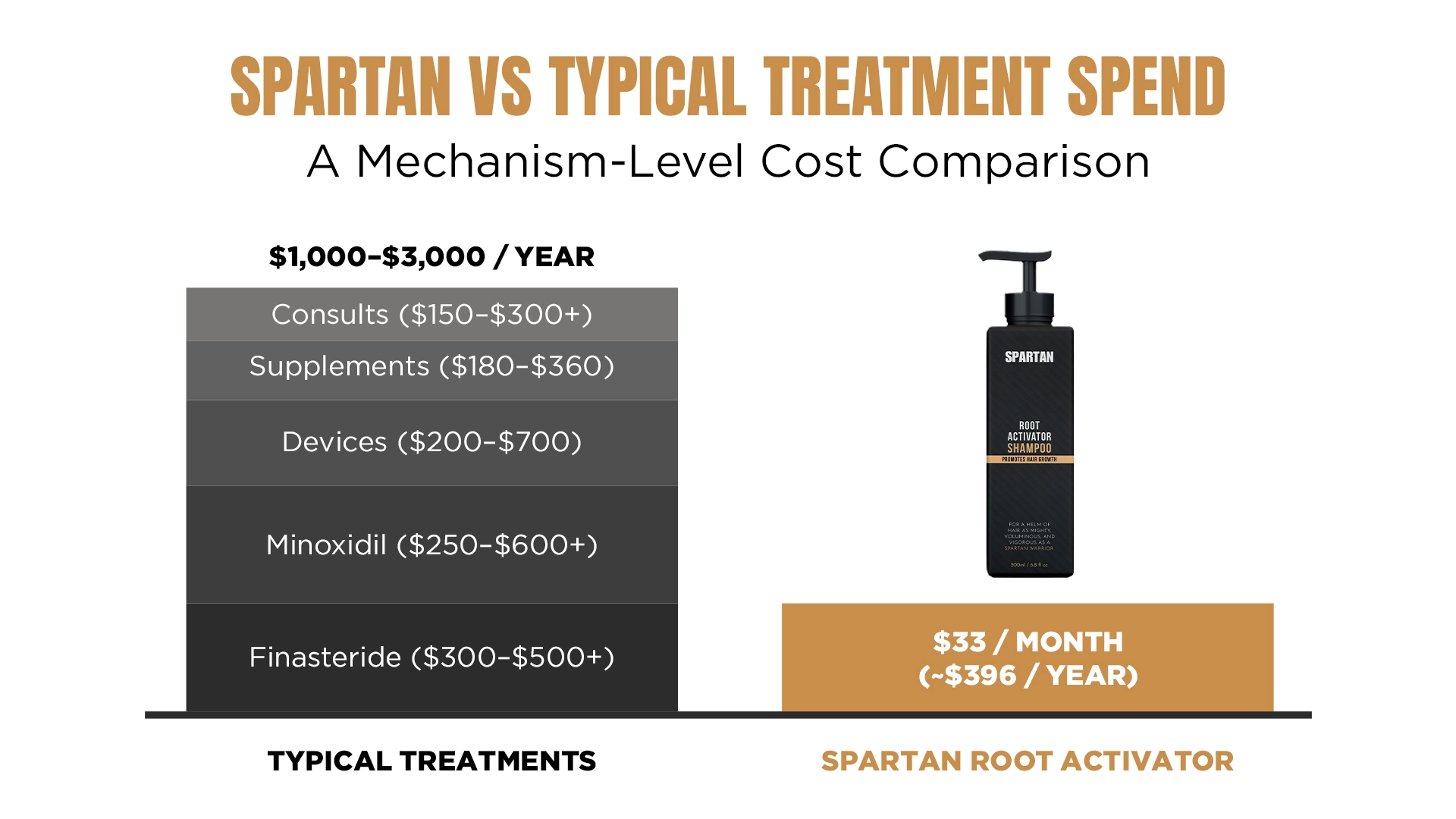
Finasteride: $300–$500/year
+ doctor visits + blood work + potential side effect
management. Addresses Stage 1 only.
Minoxidil: $250–$600/year, for life. Twice-daily application.
Addresses Stage 2 only. Everything reverses when you stop.
Microneedling/Laser devices: $200–$700 upfront. Infection risk. Inconsistent results.
Often abandoned within 6 months.
Supplements: $180–$360 over 3–6 months. No mechanism-level action on
DHT.
Dermatologist consultations: $150–$300 per visit. Usually results in a finasteride
prescription.
Total typical spend before finding something that works at
the mechanism level: $1,000–$3,000. Spread over 2–5 years of trying, failing, and trying again.
Spartan Root Activator Shampoo — the formula that addresses
all three stages — starts at
$59.95 for a one-month supply. The 6-month supply that 82% of customers choose works out
to ~$22/month. That is the cost of a dinner out.
For a formula that targets DHT suppression, blood flow
restoration, and follicle reactivation in every wash.
90-DAY MONEY-BACK GUARANTEE
Use it for 90 days. If you do not see measurable improvement —
less shedding, new growth, visible density change —
get a full refund on your entire order.
No matter how many bottles you have left. No questions asked.
Rated 4.7/5 by 18,250+ customers.

⚠️ THIS 66% DISCOUNT EXPIRES IN 72 HOURS ⚠️
After that, the price is $199.95. And units are selling out
fast.
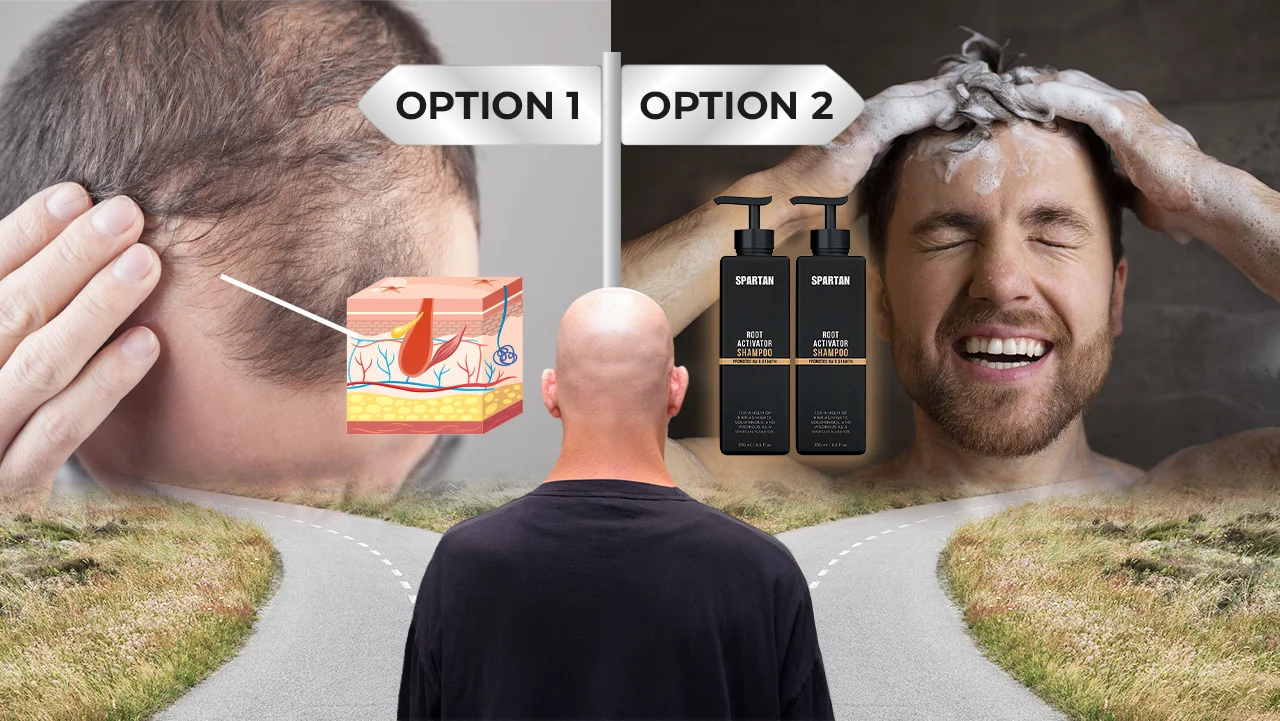
Path #1: Keep Doing What You're Doing
Keep using the shampoo that was never built for DHT. Keep
wondering if finasteride is worth the trade-off. Keep counting
the hairs in the drain. In 12 months, the follicles that are
dormant today will be harder to reactivate. The longer they stay
miniaturized, the harder they are to bring back.
Path #2: Replace your shampoo with one that was built for
the mechanism.
Same shower. Same routine. Two minutes. Four times a week. The
only thing that changes is what the formula delivers to your
follicles during those two minutes: DHT suppression, blood flow,
and the growth signals dormant follicles need to wake up.
The follicles are not dead. They are waiting.
Every day you wait, more of them go deeper into dormancy
— and the longer they sleep, the harder they are to wake
up.
HERE'S EXACTLY WHAT TO DO NEXT
1. Click the button below
that says "Check Availability Now →"
2. Choose your supply. The 6-month option covers the full
hair growth cycle and is what we recommend for best
results.
3. Use it every wash day. At least 4 times a week. Lather,
leave on for 2 minutes, rinse.
4. Give it 90 days. Set a calendar reminder. This is
biology, not magic — the hair cycle takes time.
5. If you do not see results after 90 days, request a full
refund. No questions asked.
Most men notice reduced shedding within the first few weeks.
Baby hairs by week 6–8. Visible density improvement by month
3. Full transformation by month 6.
Your hair has been waiting long enough.
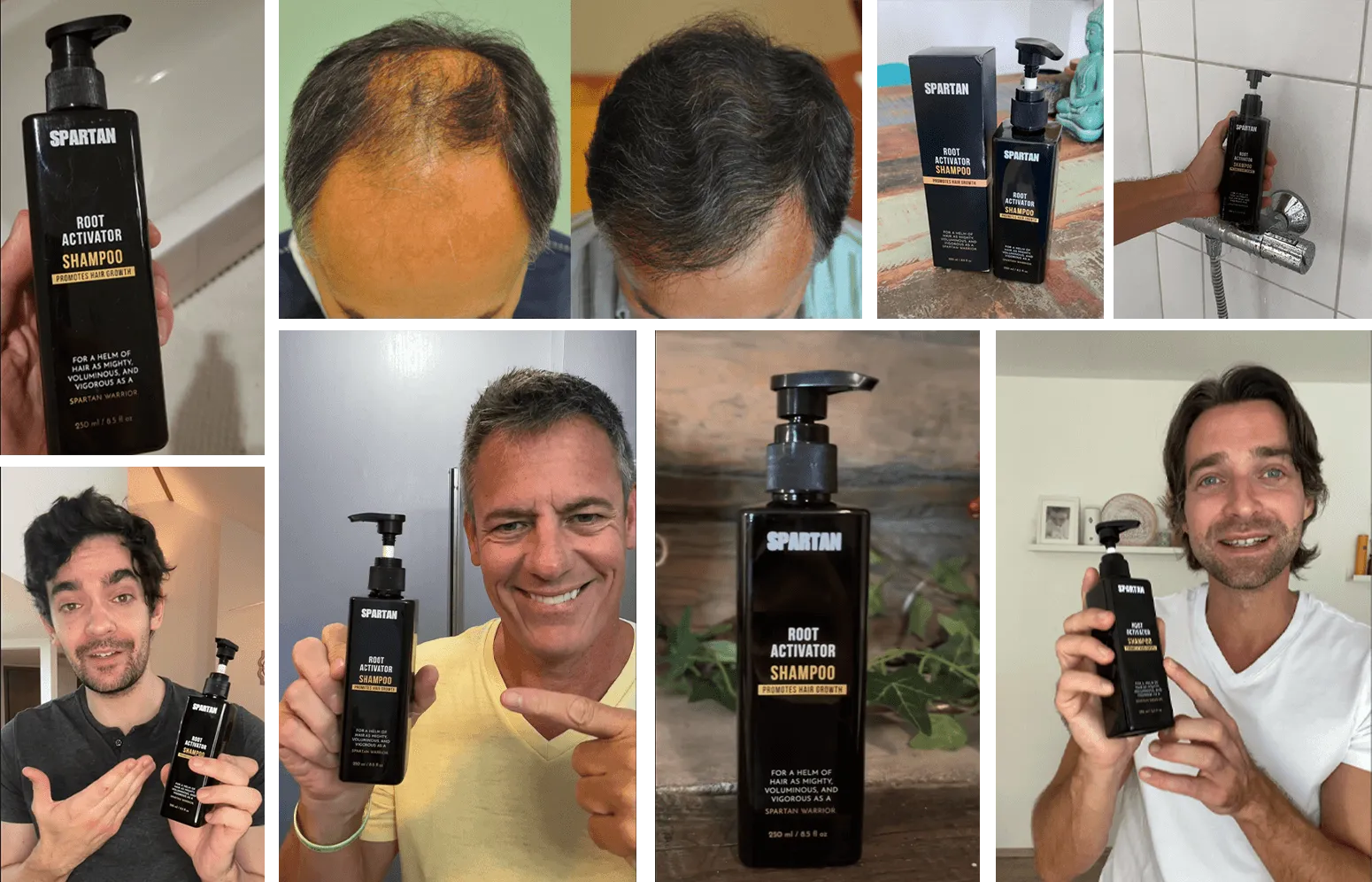
INTERNET ONLY OFFER!

FOR A LIMITED TIME:
66% OFF + THEY PAY FOR SHIPPING
P.S. - Every day you continue using a shampoo that was not
designed for DHT, you are missing the delivery window. Those
2 minutes in the shower are happening anyway. The only
question is whether those 2 minutes are working for your
follicles or doing nothing. The 90-day guarantee means there
is zero risk in finding out.
P.P.S. - If you are currently on finasteride or minoxidil, Spartan
is safe to use alongside both. Many men add Spartan to their
existing routine and then taper off the other treatments
once they see results. That is your call to make with your
doctor.
P.P.P.S. - If you have underlying health issues — thyroid problems,
iron deficiency, high stress — address those too. No topical
product can override a systemic health problem. But if your
bloodwork is normal and your hair is still thinning, DHT is
almost certainly the primary driver. And Spartan is the most
complete topical formula we have found to address it.







4 · 39 min





 2
·
2 h
2
·
2 h